Introduction: The Moment of Choice
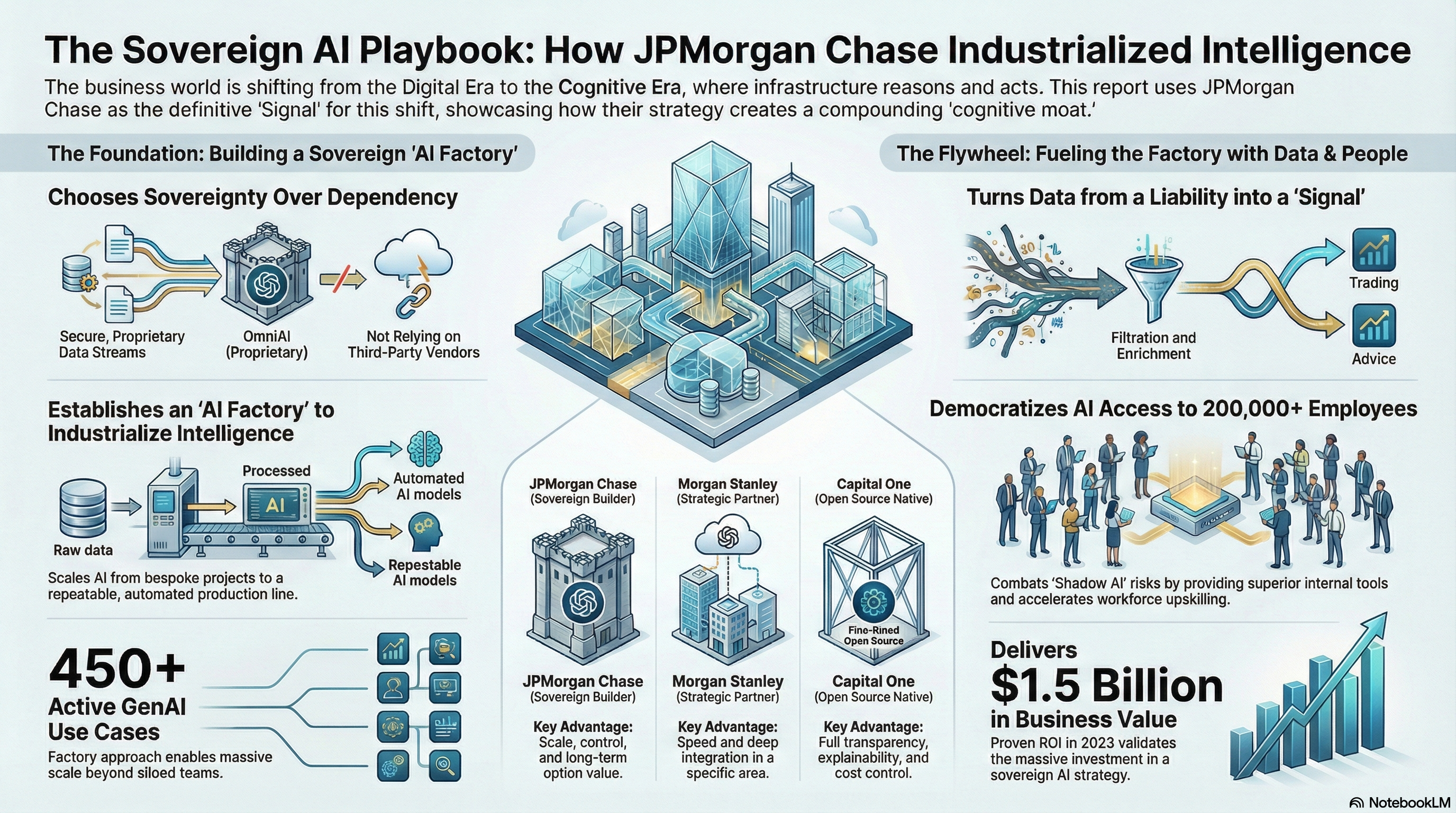
When generative AI burst onto the scene, most companies paused to worry about the risks. JPMorgan Chase accelerated. In late 2025, CEO Jamie Dimon confirmed that the bank’s $2 billion AI investment had already matched its cost in savings—a remarkable return on what many competitors were still treating as an experiment. For JPMC, AI was never a product to buy off a shelf. It was a core capability to be built from the ground up.
This case study explores the key strategic decisions (the “Decision Nodes”) that allowed JPMorgan Chase to harness the power of AI at an industrial scale. We will dissect how the bank transformed a potential threat into a powerful competitive advantage, establishing itself as a leader in the new era of enterprise AI.
1. To Build a Factory or Buy from a Store? The OmniAI Platform
Key Insight: High upfront CAPEX yielded long-term agility and data security. Building a proprietary orchestration platform prevents vendor lock-in and allows optimization of cost/performance per task.
Every company staring at the AI revolution faced a fundamental choice: Build vs. Buy. The simple analogy: should you buy a pre-made power tool from a store, or build your own workshop capable of creating any tool you need?
With its $18 billion annual technology budget, JPMorgan Chase chose to build the factory. The result is OmniAI, a proprietary platform that serves as the foundation for all AI development at the bank. OmniAI functions as an Operating Environment designed to create, manage, and safely deploy hundreds of different AI tools.
This build strategy provided three critical benefits:
Data Security: JPMC is the custodian of 500 petabytes of highly sensitive financial data. Addressing the challenges of Data Gravity and Residency, OmniAI was designed to bring the compute to the data, meaning the AI models run inside JPMC’s secure perimeter. Sending this information to an external company would be slow, expensive, and a major security risk; with OmniAI, the data never has to leave home.
Future-Proofing: The AI world moves fast. Today’s best model (like GPT-4) could be obsolete tomorrow. OmniAI is built on the principle of Model Agnosticism, which means JPMC can easily swap different AI models in and out of their systems without rebuilding everything. This prevents them from being locked into a single technology vendor and allows them to always use the best tool for the job.
Governance as Code: For a global bank, rules and regulations are non-negotiable. Instead of relying on human checklists, OmniAI builds governance rules directly into the system’s code. For example, it can automatically detect and mask private customer information before it’s processed by an AI. This automates safety and ensures that innovation doesn’t outpace control.
The build-vs-buy choice set a clear strategic path for the bank:
| Strategy | The Sovereign AI Path (JPMC) | The Traditional Safe Path |
|---|---|---|
| Approach | Build a proprietary platform (OmniAI) | Buy ready-made tools (e.g., vendor Copilots) |
| Key Trade-Off | High initial cost and effort | Quick setup, but dependent on vendors |
By building its own factory, JPMC gained control over its AI destiny. Now, the question became: what raw materials would this factory use to produce intelligent insights?
2. To Treat Data as a Lake or a Product? The Signal Strategy
Key Insight: Data Mesh as a product beats Data Lake as a repository. This approach turns data from a cost center into revenue-generating “Signal.”
An AI model is only as smart as the data it’s fed. Foundation models trained on the public internet know a lot about the world in general, but they know nothing specific about JPMorgan Chase’s clients, markets, or transactions. The bank realized its true competitive advantage was its vast ocean of proprietary data.
But instead of just storing this data in a passive data lake, JPMC decided to actively refine it into valuable, productized insights called Signal. These Signal products are not just reports; they are high-fidelity data feeds that can be used by both human traders and AI systems to make smarter decisions.
Here are a few examples of JPMC’s Signal products:
- Signal from the Noise: A powerful market timing tool that analyzes global market data to help traders identify key trends and opportunities.
- Bull/Bear Buzz: A sophisticated tool that uses natural language processing to read and quantify market sentiment and investor psychology from news and social media.
- JPMaQS (Macro Quantitative Signals): A suite of point-in-time macroeconomic indicators that provide an information advantage over standard economic data.
A brilliant data strategy is useless, however, if the AI can’t access the data. This is where the OmniAI platform proves its value. JPMC implemented a Fusion Data Mesh architecture, which organizes all the bank’s disparate data sources into a standardized, searchable catalog. This enables a technique called Retrieval-Augmented Generation (RAG), allowing an AI to find and retrieve the exact piece of Signal it needs in real-time to answer a complex question. The factory (OmniAI) and the fuel (Signal) are designed to work together perfectly.
The result is a powerful flywheel effect, which the bank calls Data Circularity. It’s a 4-step loop that constantly makes the bank’s AI smarter:
- Ingestion: The bank processes enormous amounts of raw data every day (including over $10 trillion in daily payments).
- Refinement: The OmniAI platform and data teams refine this raw data into valuable Signal.
- Action: This Signal informs a real-world decision, such as a stock trade or a recommendation to a client.
- Generation: The outcome of that action—whether the trade was profitable or the client was satisfied—creates new data, which is fed back into the system to improve the next prediction.
With a factory to build AI and a unique supply of Signal to fuel it, the next challenge was getting these powerful new capabilities into the hands of the workforce.
3. To Restrict or Democratize? The LLM Suite Rollout
Key Insight: Democratizing to 200,000+ employees accelerates organizational learning and mitigates Shadow AI risk. Restricting access to specialist teams creates skills atrophy.
JPMorgan Chase’s next decision was perhaps its most counter-intuitive. In a risk-averse industry like banking, the standard approach to a powerful new technology is to restrict it to a small group of experts. JPMC did the opposite.
They understood the problem of Shadow AI. This is what happens when a company fails to provide good internal tools: employees, wanting to be more productive, will turn to public, insecure tools on their personal devices—like the free version of ChatGPT. This creates a massive security risk, as sensitive company data can leak outside the organization.
JPMC’s solution was radical democratization. They rolled out their secure, powerful LLM Suite to over 200,000 employees. By giving everyone a tool that was not just secure but objectively superior to the public alternatives—because it was connected to the bank’s proprietary Signal and internal data mesh—they brought AI usage back into the light. Rational employees will always choose the more useful tool, aligning their desire for productivity with the firm’s need for security. This move has scaled the bank’s capabilities from a few fraud models to over 450 active GenAI use cases.
Employee usage quickly centered around three key areas, known as the Use Case Triumvirate:
| Use Case Vector | Description | Tangible Impact |
|---|---|---|
| Knowledge Synthesis | The AI acts as the Ultimate Librarian, summarizing complex documents, regulations, and research. | Reduces analysis time from days to minutes. |
| Coding & Engineering | The AI helps developers write, test, and translate computer code, including modernizing old systems. | Provides a 10-20% productivity increase. |
| Employee Assistance | The AI acts as an instant helpdesk for internal questions about finance, IT, or HR policies. | Frees up human support staff from routine queries. |
The rollout changed how employees think about their work. The role shifted from creator (writing the first draft of an email or code) to editor and orchestrator (prompting the AI and refining its output). Having successfully deployed AI to its internal teams, JPMC turned to the highest-stakes area of all: interacting with clients.
4. To Replace or Empower? The Cyborg Advisor
Key Insight: Deploy internal “Cyborg” models before client-facing ones. Building a Trust Framework internally creates the data and confidence needed before facing the market.
The most sensitive decision for any company is how to use AI with external clients. A single mistake could have severe reputational and financial consequences. JPMC’s approach was cautious but forward-thinking.
They developed Connect Coach, a specialized AI tool for advisors in its Private Bank. The tool’s function is to analyze a client’s investment portfolio, combine it with JPMC’s proprietary Signal on market trends, and suggest the Next Best Action for the human advisor to take.
This reflects JPMC’s Cyborg strategy. The goal is not to replace the human advisor with a robot. Instead, the AI acts as a coach or co-pilot, empowering the human to make faster, better-informed decisions. This human-in-the-loop approach has already proven its value, cutting the number of manual exceptions by 50% and reducing turnaround times by 75%.
To manage the risk of this powerful tool, JPMC closely tracks a key metric: the Intervention Rate, or how often a human advisor overrules the AI’s suggestion. The bank’s leadership will only consider exposing the tool directly to clients when this rate drops to near zero, proving the system’s reliability. This creates a new strategic crossroads with two possible futures:
Scenario A (Internal Only): The tool remains an Advisor Super-App used exclusively by JPMC employees.
- Pro: This maintains the valuable human touch of private banking and eliminates the risk of an AI giving flawed advice directly to a client.
- Con: This approach doesn’t scale; the bank’s reach is still limited by its number of human advisors.
Scenario B (Client-Facing): The tool evolves into a Robo-Advisor 2.0 that clients can interact with directly.
- Pro: This would be infinitely scalable, offering 24/7 financial advice to a much broader market.
- Con: This path carries high regulatory risk and could devalue the premium, relationship-based service the bank is known for.
By perfecting the tool internally first, JPMC is carefully gathering data and building trust in the system before making the high-stakes leap to direct client interaction.
5. To Treat Governance as Friction or Foundation? The AI Constitution
Key Insight: Governance as Code enables faster deployment, not slower. Automated safety checks and an AI Constitution allow rapid scaling while maintaining control.
In the tech sector, governance is often viewed as friction—red tape that slows down innovation. In banking, governance is the product. Clients trust JPMC not because it has the best code, but because it has the best controls.
JPMC’s strategy treats governance not as a compliance checklist but as a strategic enabler. By building an AI Constitution (a set of encoded principles that every model must pass) they can actually deploy models faster because the safety checks are automated and built into the system from day one.
The bank’s governance stack has three critical layers:
Model Risk Management 2.0: Traditional model risk management uses decision trees to assess risk tiers. JPMC has updated this framework for generative AI. A model generating internal marketing copy is classified as Tier 3 (Low Risk); a model suggesting trades is Tier 1 (High Risk). Each tier has different approval processes and monitoring requirements.
The Kill Switch: Centralization via OmniAI allows the bank to instantly decommission a model if it begins to drift or exhibit bias. This emergency stop capability is a prerequisite for deploying more autonomous AI systems. Without it, the risk of runaway models would be unacceptable.
The AI Constitution: A set of encoded principles—Fairness, Transparency, Accountability—that every model must pass before deployment. This is implemented as a Model Card within OmniAI, documenting what the model does, what data it uses, and what guardrails are in place.
This governance-first approach also solved the Shadow AI problem discussed earlier. Many organizations failed to adopt AI because they waited for perfect governance policies before allowing any usage. JPMC took the opposite approach: they established the boundaries (OmniAI security, Data Mesh controls) and then opened the floodgates. The result is a simple calculation for employees:
| Tool | Data Access | Security | Employee Choice |
|---|---|---|---|
| External ChatGPT | No internal data | Risk of leakage | Inferior option |
| Internal LLM Suite | Full Fusion Data Mesh, documents, code repos | Enterprise-grade | Superior option |
Rational employees will always choose the more useful tool, which happens to also be the secure one.
Finally, as the bank moves toward Agentic AI (systems that can act, not just advise), the risk profile shifts from informational to operational. If an AI agent executes a wire transfer, who is responsible if something goes wrong? The developer? The user? The manager of the agent?
JPMC is addressing this by maintaining human-in-the-loop oversight for all significant actions. Current agents are Drafting Agents (preparing the wire) rather than Signing Agents (sending the wire). The transition to signing authority will likely require a new class of digital identity for bots, where AI agents have specific authority limits just like human employees. This careful, staged approach to autonomy reflects the same deliberate strategy we’ve seen across all of JPMC’s AI decisions.
The Sovereign AI Playbook: Visual Summary
Looking Ahead: A Strategic Roadmap for Enterprise Leaders
The decisions made by JPMorgan Chase offer more than a case study—they provide a strategic framework that enterprise leaders can audit themselves against.
The Cognitive Moat Framework
Every organization should ask three fundamental questions:
Do you own the Orchestration Layer? Do not settle for vendor dashboards. Build or procure a model-agnostic orchestration layer (like OmniAI) that gives you switching cost advantage. If you’re locked into a single vendor’s ecosystem, you’ve ceded control of your AI destiny.
Is your Data a Swamp or a Signal? Invest in Data Mesh architectures. Data that is not productized via APIs is invisible to generative AI. The value of your AI is capped by the accessibility of your data. A brilliant model connected to a disorganized data swamp will underperform a mediocre model connected to refined, accessible Signal.
Are you democratizing or hoarding? Democratize with guardrails. The velocity of learning in your workforce is a leading indicator of future competitiveness. A restricted AI strategy leads to Shadow AI and skills atrophy. Give your people better tools than they can find on the public internet, and they’ll use them.
The AI Factory Implementation Guide
The shift from use case thinking to factory thinking follows a four-step progression:
| Step | Action | JPMC Equivalent |
|---|---|---|
| 1 | Establish the Platform | OmniAI orchestration layer |
| 2 | Define the AI Constitution | Governance as Code |
| 3 | Democratize Access | LLM Suite to 200,000+ employees |
| 4 | Productize the Signal | External monetization of data products |
Organizations that complete all four steps build a compounding cognitive advantage. Those that stop at Step 1 or 2 remain in experimentation mode while their competitors industrialize.
Conclusion
The Signal from JPMorgan Chase is unambiguous: the era of AI experimentation is over. The era of AI industrialization has begun.
The choices made by JPMC—sovereignty over convenience, democratization over restriction, data products over data lakes, and governance as enabler rather than friction—have set the standard for the modern enterprise.
For the rest of the market, the risk is no longer doing AI wrong. The risk is doing AI too slowly while the sovereigns compound their cognitive advantage. The gap between the Signal and the Noise is widening, and the time to choose a side is now.