The Strategic Imperative: Moving from Experimentation to Economic Value
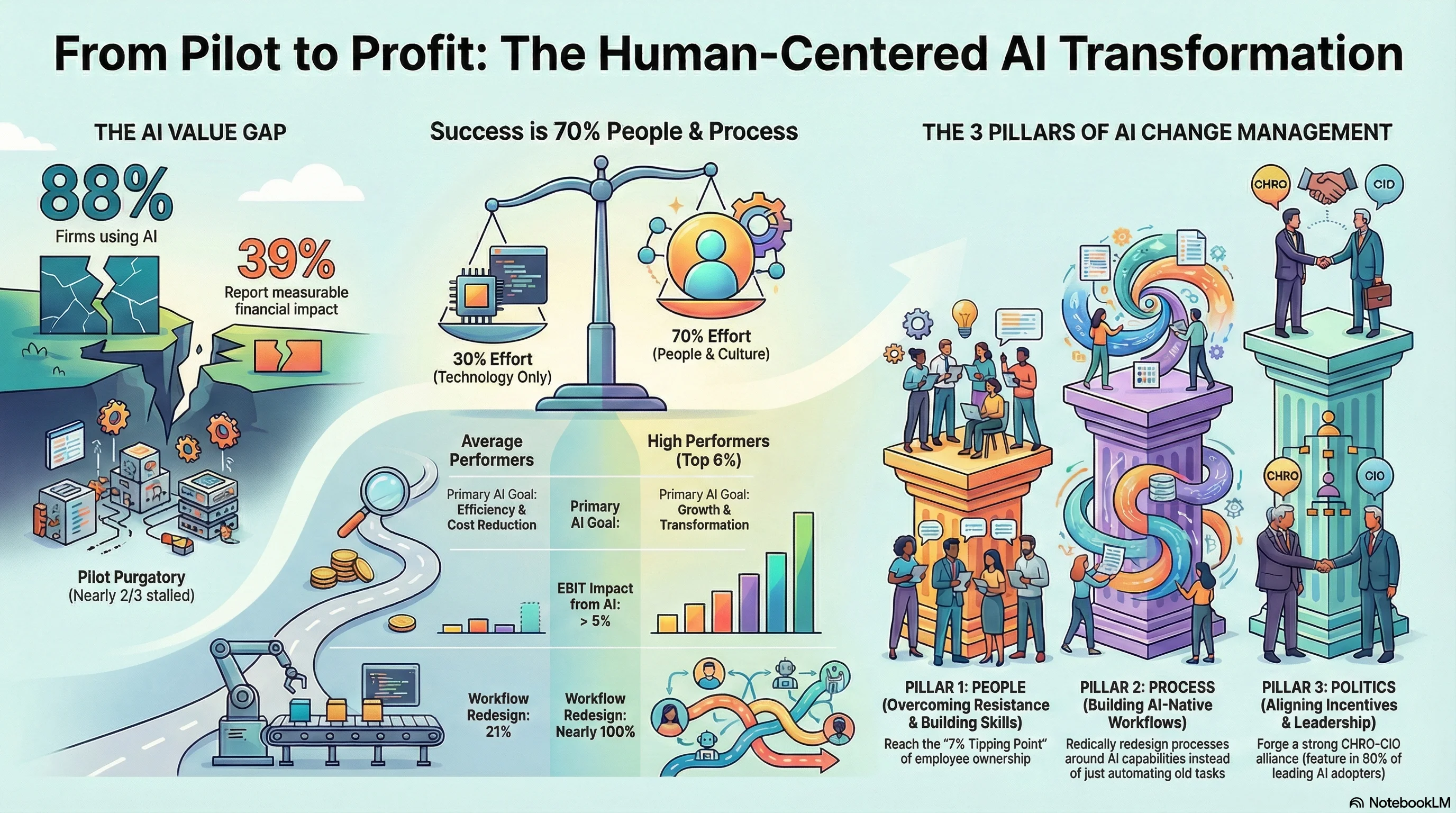
The enterprise AI landscape has reached a critical inflection point where massive capital is at risk. With enterprise buyers pouring $4.6 billion into generative AI applications and overall AI infrastructure spending hitting $47.4 billion in the first half of 2024, the deployment of AI is no longer a competitive differentiator. While 88% of organizations now utilize AI, the transition from implementation to economic value remains a direct threat to shareholder value for the majority.
Key Insight: Only 39% of enterprises report any measurable EBIT impact from their AI initiatives. The primary challenge has shifted from technological availability to organizational readiness and the sophisticated management of change.
1. The Widening Performance Gap
A stark divergence exists between a small cohort of “high performers” and the rest of the market. This elite group, representing just the top 6% of organizations, is defined by its ability to attribute 5% or more of its EBIT to AI. Their success is not rooted in superior algorithms but in a fundamentally different strategic objective.
While most organizations focus on efficiency, high performers are three times more likely to use AI for growth, innovation, and market transformation. This strategic gap manifests in “pilot purgatory,” where nearly two-thirds of organizations remain stalled, unable to scale their AI initiatives beyond isolated, single-function pilots precisely because they lack a strategy for enterprise-wide workflow transformation.
| Metric | High Performers (Top 6%) | Average Performers | Struggling Organizations |
|---|---|---|---|
| EBIT Impact Attributable to AI | > 5% | < 5% | 0% or Negative |
| Primary AI Objective | Growth & Transformation | Efficiency & Cost Reduction | Experimentation |
| Workflow Redesign Rate | Nearly 100% | 21% | Minimal |
| Deployment Scope | Enterprise-wide Scaling | Single Function Pilots | Ad-hoc Experiments |
| ROI Timeline | Often < 1 Year | 1-2 Years | Unclear/Not Measured |
| Budget Allocation to AI | > 20% of Digital Budget | < 10% of Digital Budget | Ad-hoc |
2. The 10-20-70 Principle of Transformation
Key Insight: The foundational model for successful AI transformation allocates 70% of effort to people, processes, and cultural change; 20% to data and technology infrastructure; and only 10% to the development of specific algorithms.
The strategic consequence of misallocating this effort—by focusing disproportionately on the “10 percent”—is a primary driver of the high failure rate of large-scale transformations. This imbalance creates significant friction during integration, leading to substantial value leakage and explaining why massive capital investments often fail to produce meaningful returns.
To bridge the gap from pilot projects to enterprise-wide value realization, a structured change management plan is not just beneficial—it is the only viable path forward. This plan must be architected to address the “70 percent,” reconfiguring the human and organizational systems that are the true hosts of artificial intelligence.
3. The Core Framework: People, Processes, and Politics
Successful AI change management rests upon three interlocking pillars: People, Processes, and Politics. These elements form the organizational architecture that either enables or obstructs transformation. Failing to address these pillars in a synchronized, deliberate manner results in friction, resistance, and the erosion of potential AI-driven gains—a phenomenon known as “value leakage.”
People: Overcoming Human and Psychological Barriers. The human-centric challenges to AI adoption are complex. While fear of job loss is a widespread concern affecting 75% of employees, a more nuanced form of resistance often emerges from high-status professionals. For these individuals, whose professional identity is intrinsically linked to their expertise, AI is a direct threat to their status and judgment, leading to avoidance or concealment of the technology.
Processes: The Mandate for Radical Workflow Redesign. Organizations must understand that incremental improvements to legacy workflows are insufficient to unlock AI’s transformative potential. High-performing organizations do not simply “bolt on” AI to existing processes; they build entirely new, AI-native workflows. This radical process redesign is the single strongest correlate with AI success. Despite this, only 21% of organizations have undertaken this fundamental re-engineering, choosing instead to automate existing inefficiencies.
Politics: Realigning Power Dynamics and Incentives. AI inherently disrupts traditional corporate hierarchies and power dynamics. In many organizational cultures, a manager’s status and influence are tied to headcount. AI’s capacity to enable smaller teams to achieve greater output creates a perverse incentive for managers to resist adoption, viewing it as a threat to their organizational standing.
4. A People-Centric Strategy for AI Readiness
The ‘People’ pillar represents the most critical component of the 10-20-70 model. The strategic objective is not merely to provide employees with new tools, but to cultivate a workforce that collaborates with AI as a teammate. This psychological reframing is essential, with data showing that a “teammate” framing yields 85% accuracy in complex tasks versus only 82% for a “tool” framing.
The ADKAR Model for Individual Change
The ADKAR model provides a proven, structured framework for guiding individuals through the change process:
- Awareness: Ensure employees understand why the AI transformation is happening now and the strategic risks of maintaining the status quo.
- Desire: Cultivate personal motivation to engage with AI by clearly demonstrating how it reduces tedious and repetitive tasks.
- Knowledge: Equip the workforce with the practical skills required to use AI effectively, such as prompt engineering and data literacy.
- Ability: Build confidence and competence through hands-on practice and direct application in real-world job functions.
- Reinforcement: Sustain new behaviors over the long term through aligned incentives, peer recognition, and updated performance management systems.
Reaching the 7 Percent Tipping Point
Key Insight: Research indicates the tipping point for transformation is 7 percent. Transformations that reach this threshold are twice as likely to deliver total returns to shareholders that exceed their sector average—versus the current average of only 2% involvement.
“Involvement” is not passive participation; it is defined as employees having real ownership of an initiative or milestone, making them directly responsible and accountable for its delivery.
Tactical Interventions for Resistance Management
A proactive approach to managing resistance requires identifying its root causes and deploying targeted tactics:
| Resistance Driver | Prescribed Tactic | Strategic Objective |
|---|---|---|
| Fear of Job Loss | Verifiable Commitments | Guaranteed reskilling and clear communication on job security |
| Loss of Status | Private Learning Spaces | Eliminate the fear of embarrassment during experimentation for experts |
| Distrust of Output | Explainability Tools | Provide transparency into the “why” behind AI-generated decisions |
| Change Fatigue | Micro-Wins | Celebrate small, frequent successes to build positive momentum |
| Skill Gaps | Multi-Modal Upskilling | Deliver personalized, role-specific learning paths |
To overcome status-based resistance, “Identity Protection” tactics are particularly effective. Private consultation spaces allow professionals to experiment without fear of appearing incompetent. Critically, leaders must model vulnerability by openly sharing their own learning moments and failures with AI, building the psychological safety necessary for widespread experimentation.
5. A Process-Oriented Strategy for AI-Native Workflows
To unlock AI’s full economic potential, the enterprise must shift its mindset from “bolting on” AI to legacy processes to building entirely new, AI-native workflows from the ground up.
Deconstructing Workflows and Eliminating “Human Mess”
According to Gartner’s maturity model, a primary obstacle to effective AI integration is “Human Mess”—the unwritten rules, tribal knowledge, hidden manual checks, and undocumented decisions that govern how work actually gets done. A staggering 93% of organizations lack visibility into these processes, creating a chaotic environment where AI cannot function effectively.
Forcing Function: “Mission Impossible” Goals
To break the powerful inertia of legacy workflows, organizations must deploy “Mission Impossible” goals as a forcing function. By setting aggressive targets—such as requiring a task that normally takes a week to be completed in a single day—teams are forced to abandon incremental improvements. This tactic makes it impossible to succeed using old methods, compelling them to embrace AI-native solutions and rethink the entire process from first principles.
Node and Network Synchronization
A common failure mode in process redesign is “Node vs. Network” desynchronization. An organization may achieve massive efficiency gains at a single “node” in a workflow (e.g., AI-accelerated software development) only to create a debilitating bottleneck elsewhere in the “network” (e.g., a manual legal review process that cannot keep pace). Successful transformation requires mapping the entire workflow topology to ensure that improvements are synchronized across interconnected functions.
The AI Maturity Trajectory
The Gartner AI Maturity Model provides a clear roadmap for the journey from experimentation to transformation:
| Level | Maturity Stage | Characteristics |
|---|---|---|
| Level 1 | Awareness | Knowledge of AI exists; experimentation is ad-hoc |
| Level 2 | Active | Teams are playing with models, but efforts are confined to functional silos |
| Level 3 | Operational | Machine learning is integrated into day-to-day functions, supported by data pipelines |
| Level 4 | Systemic | Business models are actively being redesigned around AI with enterprise-wide coordination |
| Level 5 | Transformational | AI is no longer a tool but is the core value offering, with pervasive ML |
6. A Political Strategy for Aligning Incentives
The political dimension of AI transformation is a critical, often-overlooked barrier to success. The disruption of established hierarchies and power structures creates powerful undercurrents of resistance. A successful adoption strategy must include the deliberate re-engineering of organizational incentives to reward AI leverage over traditional metrics like headcount.
The Critical CHRO-CIO Alliance
Key Insight: 90% of organizations leading in AI adoption have forged a strong CHRO-CIO partnership. This alliance ensures that the workforce strategy—including reskilling, role design, and performance management—evolves in lockstep with the technological implementation.
When HR and IT functions operate in silos, transformations inevitably fail.
Re-architecting Hierarchy and Status
To realign managerial incentives and embed new organizational values, two specific tactics are highly effective:
The Tournament Approach: Staging departmental “tournaments” with public rankings creates a competitive dynamic that motivates managers to become champions of AI adoption. This approach rewards leaders who enable their teams to achieve more through technological leverage, shifting the basis of status from team size to team impact.
Adjusting Competency Models: The organization must signal a clear shift in what it values. By adjusting competency models to shorten the promotion cycles for demonstrated AI experts from a traditional 5 years down to 1-2 years, the company formally recognizes that technological leverage and cognitive output are now more valuable than seniority or headcount alone.
7. Building Sustainable Capabilities: From Literacy to Mastery
A successful upskilling strategy moves far beyond generic, one-off training programs. True value is created only when employees progress through a structured learning journey that takes them from foundational awareness to deeply embedded, habitual practice.
The Three-Part Learning Progression
- Foundational Learning: Imparting the core concepts, vocabulary, and critical “a-ha” moments that establish a baseline understanding of AI’s potential.
- Applied Learning: Moving from theory to practice with on-the-job training directly tied to an employee’s real, day-to-day workflows.
- Embedded Learning: Transforming new practices into ingrained habits by codifying AI-native methods into standard operating procedures, role expectations, and performance metrics.
Role-Specific Learning Journeys
A one-size-fits-all training approach is ineffective and inefficient. Learning journeys must be tailored to the distinct needs of different employee personas:
- Strategic Persona (Senior Leaders): Focus not on technical proficiency but on building a shared, compelling narrative for the transformation, learning to lead through ambiguity, and personally modeling the desired AI-enabled behaviors.
- Implementation Persona (Managers & Frontline): Requires hands-on, practical training centered on simulations and use cases tied directly to their specific workflows in functions like marketing, R&D, or operations.
The Four Core AI Skill Domains
| Capability Area | Skill Focus | Target Outcome |
|---|---|---|
| Technical Skills | Prompt Engineering, Data Fluency | Employees can interact effectively with AI models |
| Cognitive Skills | Critical Thinking, Bias Detection | Employees can critically evaluate and oversee AI outputs |
| Social Skills | Empathy, Collaboration | Teams can achieve true human-AI synergy |
| Strategic Skills | Systems Thinking, Problem Framing | The workforce can proactively identify new use cases for AI |
8. The Agentic Frontier: Preparing for Autonomous AI
The rise of agentic AI represents a paradigm shift, moving from tools that answer questions to autonomous agents that can act on objectives and resolve issues. This evolution demands a forward-looking plan to restructure the organization for a future where humans and autonomous AI agents collaborate as a cohesive workforce.
New Organizational Models: MVOs and Swarms
Leadership must contemplate new organizational models. Back-office operations, for example, can be reimagined as Minimum Viable Organizations (MVOs), where “agent swarms” oversee the vast majority of work, with a minimal human contingent focused on oversight and exception handling. In contrast, high-touch, client-facing functions will retain a larger human workforce, but these employees will be augmented with “AI superpowers” to enhance their effectiveness.
Shifting from Task Management to Outcome Management
This new hybrid workforce requires a fundamental evolution in leadership. The focus must shift from managing tasks to managing outcomes. A critical new leadership skill will be the ability to “interrogate the reasoning” of an AI agent to understand its decision-making process, rather than simply checking its final output.
Success in the agentic era will depend heavily on the ability to codify the “tacit knowledge”—the invaluable, unwritten expertise of veteran workers—into the standardized, automated norms that agentic systems require to function effectively.
9. Governance, Measurement, and Economic Frameworks
Effective governance is not a barrier to innovation but an accelerator for AI adoption. By building a foundation of trust and responsibility, governance gives the organization the confidence to scale complex AI systems.
The FATEPS Framework for Responsible AI
A responsible AI governance program must be built upon the FATEPS principles:
- Fairness: Actively work to eliminate bias in training data and model outputs.
- Accountability: Establish clear lines of ownership for AI systems and define precise escalation paths.
- Transparency: Document all model assumptions, data sources, and design choices.
- Explainability: Ensure that AI-driven decisions can be understood by non-technical stakeholders and regulators.
- Privacy: Uphold stringent data privacy standards throughout the AI lifecycle.
- Security: Protect AI systems from adversarial attacks and ensure their integrity.
Measuring Economic Impact: Total Cost of Work (TCoW)
To accurately assess the economic impact of AI transformation, organizations must adopt the Total Cost of Work (TCoW) framework. This model normalizes costs across all sources of labor—including full-time employees, contractors, and digital AI labor—providing a holistic view of operational expense.
TCoW = Labor Costs (Human + AI) + Vendor Costs + Capital Charges
This enables the calculation of Return on Work (RoW), which provides the definitive lens for optimizing the hybrid workforce:
RoW = Total Revenues / Total Cost of Work (TCoW)
Key Performance Indicators for the AI Enterprise
| Category | KPI | Definition |
|---|---|---|
| Adoption | Active AI Users % | Percentage of employees using AI on a monthly basis |
| Engagement | Prompts per Active Seat | Average number of AI interactions per user per day |
| Proficiency | Time-to-Proficiency | Days from first use to consistent, sustained usage |
| Efficiency | Cost per Prompt | The financial efficiency of each interaction with an AI model |
| Impact | Productivity Impact Score | Measurable improvement in employee output, speed, or quality |
| Health | Model Drift / Hallucination Rate | Frequency of incorrect or shifted model outputs |
Strategic Recommendations: The Implementation Roadmap
This plan synthesizes the preceding analysis into a concise set of actionable recommendations for executive leadership:
Establish a North Star
Define a bold, simple, and compelling vision for how humans and AI will collaborate to create value in the future.
Redesign Workflows
Do not automate existing, inefficient processes. Instead, commit to building new, AI-native workflows from the ground up.
Forge the CHRO-CIO Alliance
Ensure that the organization’s technology and talent strategies are unified and co-developed from the outset.
Invest in Role-Specific Learning
Move beyond generic AI literacy programs to deliver applied and embedded learning journeys that build true mastery in the context of daily work.
Implement Robust Governance
Use a responsible AI framework not as a constraint, but as an accelerator to build the trust and confidence required for broad adoption.
Target the 7% Threshold
Focus on achieving deep, meaningful involvement from at least 7% of the workforce to reach the critical tipping point for sustainable change.
The Change Management Playbook: Visual Summary
Conclusion
Success hinges on treating AI transformation not as a technology project, but as a strategic business imperative. By systematically reconfiguring the organization’s people, processes, and politics around this new reality, the enterprise can finally bridge the gap between pilots and profits.
The organizations that move now—with the 10-20-70 principle as their guide, the 7% threshold as their target, and governance as their accelerator—will define the next era of competitive advantage. The rest will watch their AI investments evaporate into pilot purgatory.